Get higher ranks on Google with Search Engine Optimization !
Professional Search Engine Optimization services to give your websites the visibility through search engines and the social media channels.
Become an SEO Expert, and get the edge over others!
Have a website that needs help with SEO? Contact me with your details now for a personalized, custom review.
Become an SEO Expert, and get the edge over others!
Have a website that needs help with SEO? Contact me with your details now for a personalized, custom review.
Feb
06
Filed Under (Search Engine Optimization) by Mani Karthik on 06-02-2008
As you might already know, titles and title tags are often seen carrying more weight than any other on site optimization factors be it on blogs or static webpages. And I bet, that it’s the one thing all of us tweak mostly to try and reposition yourself on the SERPs.
Well, the liking to the title tag may be due to various reasons.
- It is one of the most easily spotted onsite optimization factor.
- It is easy to tweak it.
- Lots of options are available, which makes it fun.
- It has almost a direct and immediate effect on the Google SERPs.
Apart from all these options, it is also true that it’s difficult to get the right combination of keywords, that will give you the maximum results on the SERPs. So the challenge for an SEO would be to find this right combination and the perfect title tag.
Before going into the perfect title tag, let’s see what are the “don’t do’s” with title tags?
Well, one word would be enough to explain it all - Spam. With all it’s flexibility and weightage, it’s very easy for SEO’s to get high with it and screw it all up. We’ve seen lot of examples in the near future that were “study materials” on how not to write a title. Just go Google down “SEO India” and you will find some really interesting ones.
Now, watching those sites rank high for a particular keyword using the so called “title spam” and “title keyword stemming”, would naturally throw this question across to you - “Why can’t I do a keyword spam on the title tag, when it will deliver the results? After all, that’s what my client is keen on.”
Very honest question and a dangerous one at the same time. My answer to that question would be another one?
“How long do you want your site to appear number one-ten on the SERPs ? ”
Choice 1 - A few months
Choice 2 - As long as the site exists
If it’s choice two…..yep you got it right man…you better not spam.
A spammy title tag would look something like “SEO India, SEO services India, SEO Indian, Indian SEO, The SEO India, SEO Indias”.
I must appreciate this webmasters English creative writing skills but seriously this is no better than a high school guy.
“I read it at Aaron’s E-book that you should include your keywords in the title tag so there you have it, all the ten versions of the keyword! ”
Rather than doing good, this kind of practice will give you bad reputation (if not immediately) in the long run.
So what is a good title tag? How does it look like?
A good title tag is
- A healthy one.
- A short and sweet one.
- Both visually and technically appealing.
Now, this is old school isn’t it? We all know that good title tags are supposed to be the short and sweet, non spammy and all that but, when our competition is tough (and they are spamming) how can I make sure that I reap my profits ?
Well, that’s the catch my friend. That’s what makes you unique.
- Use your keywords “wisely” on the title.
Just because you heard that you got to fix your keywords on the title, you don’t have to repeat it and make it look like spam.
Let’s see it like this. Only you know what your keywords are, not your readers. Draft a title so that your readers can’t make out what your keyword are. It should be a carefully drafted copy that “includes” the keywords in a natural way.
Ex: SEO India, SEO India Services,SEO India outsourcing, SEO from India - NOT good. It shows that your keyword is SEO India.
Good Ex:- SEO outsourced services in India from - your company name -. - Use your competition to your advantage.
Analyze all your competitors. See if they follow a pattern. If they’re all spammers, you have an opportunity to beat them. See what’s a better copy for you to break into all of their positions. *Food for thought*
- Makes sure the title makes sense to a reader.
Read out your title tag to your colleague or friend. See how he responds to it. Don’t just think of all that you can and plug it in. - Let there not be just keywords, but synonyms too.
Synonyms are a great way to build traffic. Repeating the same keywords in combination with other words may get you the spam tag, but adding it with synonyms is a better alternative. - Special characters on the title tags.
Let there not be any complicated characters in your title. I’ve seen people place funny symbols like tilde and ambersand to create a visual impact. In fact it does but reader’s probably might like you to use, even that much space for some more information. .::[ So use it ]::.
Essentially, titles are like your visiting cards to a site. You can create and print them in whatever ways you like it. But if you really want a information seeker to read/access you, you better give them the information they are looking for and let that be in good, simple and understandable language.
Dec
30
Filed Under (SEO Tips) by Mani Karthik on 30-12-2007
This is an interesting case study for everyone.I hope my readers from outside India give me their sincere opinion on this and not dodge the question. Here goes.
Recently, at a conference I remember the CEO of a popular Indian SEO company proclaim that their company ranks high on Google for the term “SEO India”. And this should show others how good they are and what great deal of business they do.
Honestly, this seemed like a baseless statement to me because, for any SEO company, ranking high for a particular term cannot (underline) bring them real business. I’m talking about real good, genuine, healthy business. From my experience, I’ve learned that good business always come from referrals. And for referrals, there needs to be an incredible amount of credibility towards the company. By just ranking high for the term SEO India, can give you probably one time clients, but if you lack in quality, that’s the end of it. For it’s a service not a product we sell.
And I’ve enough reasons to think that company’s that boasts of ranking high for the term SEO India are bogus themselves! First off, the term SEO India, as suggested by the CEO gentleman itself is not a popular word among clients (US and UK predominantly). Because of the poor quality of services offered by many SEO companies in India, there is a widespread belief that all SEO’s in India are weak, which is not true.Yes, there are weak ones, but not all are.
Out of all my clients that I deal with today, almost everyone (this is shameful) has had a bad experience with an Indian SEO. The common issues raised are that, the so called “professional SEO’s” does not reveal to the clients what they do with their site. They don’t tell them where they are sourcing the incoming links from, they don’t tell them why they are using a particular keyword on the meta tags, they don’t even tell them what they should do with their duplicate content on the site.
I’ve heard this issue with many clients and I think they have all good reasons to complain that Indian SEOs are poor quality. Now, if we further investigate into this problem, we can find some interesting equations.
Normally when a client wants to outsource their SEO work to India, they’d normally go googling. And they are likely to go ahead with the first few companies that they find on Google ranks. The problem arises here. Out of the top rankers for the term SEO India, on Google, many so called “professional” companies use keyword stuffing and hidden text to make it to the top.
Why that frown on your face? Check it out yourself. I don’t want to take names but it is disappointing to see that even in the top results, many of them use the words SEO India, SEM India, SEO company India and many similar keywords either extensively on the top header, in the ALT tags, in the title, more like spam often repeated and in lines with black hat methods.
One simple question here -
If these companies will do such kind of unethical SEO practices to get better ranks themselves, would not they do similar unethical strategies to the clients?
Indeed they will. Now, that explains it all. Doesn’t it ?
Okay, coming back to my readers outside India, I’m just curious to know, what keywords will you use to search for an outsourced SEO firm?
Google Trends shows that nobody outside India uses the search term “SEO India” on Google. Absolutely none. My opinion is that it is the SEO firms in India that are competing among themselves to rank for this term (See the number of ad results on Google), and not any genuine potential client. He might be searching for other keywords but definitely not SEO India. In order to test this out, I’ve changed my title tags and metas to feature the keyword SEO India, I’m just curious to see how much traffic this change is going to bring?
Dec
20
Filed Under (Blogging) by Mani Karthik on 20-12-2007
Have you ever had the chance of having a traditional Indian meal ? For the Indian readers, this question is irrelevant but for the rest of the world, this article might be interesting and mouth watering at the same time.
The (grand) Indian meal is pretty popular, particularly the south Indian one. Once, a foreign friend of mine who had the chance to have one jokingly said, that the thali itself reminded him of the solar system model he learned at school. Huh? He said, the rice is the sun (being at the middle), and there are lot of planets and their satellites revolving around it making it look almost like a solar system.

Well, I’d agree him on all points except that, in the traditional Indian meal, eating the sun won’t burn you, but the curries (the satellites) may, they are very spicy.
Having said that, I think there’s lot of points in common between having an Indian meal and blogging.
- Template.
In blogging, it is essential that you have a cool template, good enough to get the attention of the reader. Similarly, in the meals, there’s the template - the plantain leaf. A plantain leaf is used instead of a plate, which must be large enough to carry all the ingredients well.
Similarity - 80%. - Starters.
In both blogging and the meal, there are the starters. In blogs they are the headers and above the fold stuff. If the starter is good both the meal and the blog is enjoyable. In the meal the starters are placed “above the fold” and also in the blog.
Similarity - 99% - Main course.
And there’s the main course which is rice and the curries. In the blog, there are the articles in different categories. Having a good main course fulfills your hunger, be it a blog or the meal.
Similarity - 99.7% - Dessert.
In the meals, there is a always something sweet at the end. It normally would be “payasam”. And in blogging, there are the comments. Comments, though not always sweet, is definitely a dessert!
Similarity - 59% - Addiction.
Both the meal and blogging is addictive! If you taste it once, whenever you think of one, your mouth starts watering and you can’t get rid of it. Everyday, new tastes, new flavors, a whole new meal !
Similarity - 70% - Widgets.
In the blog you have the widgets to spice you your blog. Like the Lijit widget or the Mybloglog widget, and in a meal, you have the pickles and banana chips that sits alongside the main template , though very small, adding to the spice of the blog.
Similarity - 85.6% - SEO and the thali meal.
A thali meal is very much like doing a search engine optimization on your blog. As you know, in SEO, there are some procedures that has to be done methodologically in order to put yo in good shape. Like the keyword saturation and onsite optimization procedures. In an Indian meal, the order of serving the meal is really important. First, the spicy pickle, then some banana chips, then some curries, then the rice, then the sambhar(spicy curry), then the next set of curries!
It sounds more or less similar right? If you mix up the order neither the meals is enjoyable nor the blog. You have to serve every ingredient in the same proportion.SEO - Keyword density - You sprinkle the keywords here and there to meet the right density.
Meals - Salt - You sprinkle the salt to meet the right density.SEO - You make sure that the template is search engine friendly by ensuring a standard three column template with a proper header and footer.
Meals - The template (plantain leaf) is very much like the template with the header to one side and the footer(tapering end) to another.
Seven reasons to think that an Indian meal is similar to blogging - there you have it. Now, some of the points may sound bizzare, but if there’s at least a 50% similarity that you found, I’d be happy!
Nov
17
Filed Under (News) by Mani Karthik on 17-11-2007
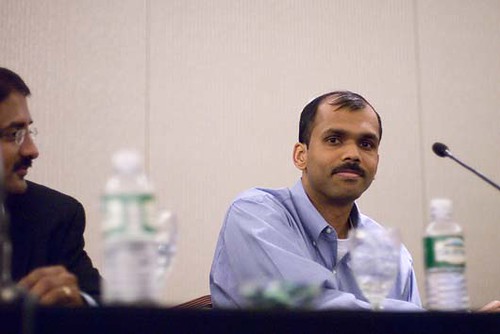
Gokul Rajaram, was the Product Manager at Google handling a number of it’s advertising products. At this role, Mr. Rajaram’s duties included defining new features and enhancements to Google’s advertising programs and working with engineering on implementation. So, many of the features you see on the Google AdSense is the result of this man’s brainwork.
Earlier in his career, Mr. Rajaram was a Technical Lead at Juno Online, an early internet service provider that is now part of United Online, the second largest ISP in the US. At Juno, he was part of the team that developed Juno’s online advertising platform. Mr. Rajaram has also worked as a Software Engineer at Sun Microsystems, and as a Product Manager at Onetta, a telecom hardware company.
Mr. Rajaram earned his M.B.A. from the MIT Sloan School of Management, his M.S. in Computer Science from the University of Texas at Austin, and his B.Tech in Computer Science from the Indian institute of Technology, Kanpur, where he was awarded the President of India’s Gold Medal for being class valedictorian.
He is believed to be one of the “Godfather’s of AdSense”, one of the most successful products at Google.
Now the sad news is that Gokul is leaving Google (he has already) to be on his own. He has not revealed what his future plans are but it’s believed that he’s going to start on his own. Would that be a competitor to Google’s AdSense? No idea.But to us bloggers, that would be music to ears, wouldn’t it ?
It is a trend now that many Googlers are leaving company either to start up companies of their own or to join smaller but upcoming and fast growing companies like Facebook.
Oct
31
Filed Under (Social Media) by Mani Karthik on 31-10-2007
PicSquare, which provides “photo based gifts” services in India, has come up with a new feature for their users. A photo blog, where users can upload and store pictures like albums or blogs - a photo blog as they would call it.
Manish says -
To continue our effort to provide best value in online photography to Indian users we are launching a new feature at Picsquare (http://mysite.picsquare.com). The new feature – Personal Photo Site, will allow users to create their own photo website and could be described as blogs for photographs.
Some of the main features of the photo blog are:
- Personalized domain name like http://manish.picsquare.com
- Theme selection, variety of theme option available like weddings, vacation, birthday, family etc.
- Customized home page
- Permission control, user can make his site accessible to anyone or decide who can get access
Hope this tool will help users to share more and order more .
Picsquare had completed 1 million images last week.
Sep
27
Filed Under (Social Media) by Mani Karthik on 27-09-2007
Everyones carrying a digital camera these days. And everyone’s clicking lot of pics too. Where do you store these files?
If you prefer your PC that means you are going to run out of space sooner or later. You would be using flickr or picasa otherwise..but there’s storage limit for free users at these services too. Have you tried making good use of these photos other than storing it online and sharing it with your friends? May be printing your friends picture on to a tea cup and sending him on his birthday? Cool isn’t it?

Picsquare is an online portal that helps you to do just that. And if you are in India it’s damn cheap too (I wouldn’t be promoting it otherwise). To print your photo on a tea-cup, it costs only Rs 299 and to print on a T-shirt it costs only Rs 399/-. That’s cheaper than you thought I bet!
Picsquare accepts credit cards, but I’ve had a few glitches the first time i tried to order a coffee-cup. But they were quick to sort it on intimating about it on email. I think this is a very good application and an excellent idea for Indian startup , when there are a lot of NRIs who would want to gift personalized gifts to their folks in India.
The site is neatly designed, even though from the SEO perspective, like all Indian startups, it does not perform well. There is unwanted clutter of script on the landing page and keywords(if at all any) are not highlighted.
But a cool service, you must try.
Sep
12
Filed Under (Fun) by Mani Karthik on 12-09-2007

There are a lot of blogging talents around, that we often over look just because we are so used to think about our own blog only. Nirmal TV is an active blogger in the blogosphere here in India. His blog Life Rocks 2.0 features articles on technology, tips and tricks, blogging, tutorials and the internet ! I’ve been very impressed with his socializing skills in the Indian Arena of blogs. His blog receives on an average 20 comments on every article. Pretty cool that is!
I’m still unsure how he’s able to make others comment on his articles. However one thing that I noticed is that Nirmal himself makes it a point on other blogs too. And most of the commenters on his blog are reciprocal commenters. Which is not bad at all.
When a first time visitor comes to his blog, they’ll see a lot of comments and gets a good impression about him. And he’s likely to grab his feed. This is a great lesson to learn from Nirmal.
Nirmal is up-to-date on technology within his reach, and often strikes a point blogging about it prior to anybody else. Clever! Something to be noted about Nirmal’s articles is that he churns out lot of “Numbered lists”. Like Top 10 themes, Top 10 plugins and the like which gets dugged and stumbled upon by his readers which in turn gives him lot of traffic. Interestingly, Nirmal prefers lists with odd numbers like 7 and 9 rather than 5 and 10, which are very common on the internet.
Apart from all these stunts, Nirmal is out to grab more organic traffic online by harnessing the power of SEO. He’s approached me for a quote too. Too clever!
Aug
14
Filed Under (Uncategorized) by Mani Karthik on 14-08-2007

Photo courtesy pinklovesbrown
There’s happy news for Indian users this Independence day from Google. On the official Google blog, M T Raghunath and Gokul Nath Babu Manoharan, Software Engineers, Google has made this official announcement.
Happy 60th birthday, India! We can’t wait to celebrate, but we’re going to wait a few days for the formal unwrapping of our gift to Indian users. Check back and we’ll have news shortly.
Hmm… what could it be? Here are my guesses..
- Blogger new features update
- More features on AdSense
- Tricolour ipod for top AdSense publishers
Yeah, they are wild guesses, i know. Any clues?
Jun
11
Filed Under (Search Engine Optimization) by Mani Karthik on 11-06-2007

Jun
07
Filed Under (Blogging) by Mani Karthik on 07-06-2007
There’s news for you, Indian bloggers. The new blogcamp is here! This time @Pune.
BlogCampPune is a free unconference focusing exclusively on blogging, organized by bloggers for bloggers. It‘s built upon the principles of the famous BarCamp (ad-hoc unconference) focussed on sharing, learning and new ideas. This is going to be an intense event with discussions, demos and interaction between attendees. Any blogger who wants to contribute is welcome and invited to join. In the spirit of BarCamp, if you attend, be prepared to present something (even if it’s just 10
minutes).
See the official page for details
You can add your name at the Wiki if you are attending.
If you would like to endorse this camp, use one of this badges on your blog.
-
Sponsors




-

- »About Mani Karthik
Mani is a blogger and SEO/SMM consultant from India ,working on search engine optimization and social media management projects for clients, small and big, across the world. Contact me if you think you need my help. More -
How to use AllinOne SEO plugin to fullest potential from ManiKarthik on Vimeo.

 |
 |
 |
 |
 |
All copyrights reserved 2008 DailySEOblog.com About Mani Karthik | SEO for Wordpress | SEO Consultation | Search Engine Optimisation Tips | Privacy policy |